

Pencil and Watercolour Sketch of Dylan Sara
Day Thirty-Five of Sketching People
Continuing with day 35 of my #Kick365 sketching challenge to draw people in ink and watercolour. We had a little road trip today to El Rompido in Spain. From the Portuguese border it’s on about 35 km, so well within the range of a day trip. I didn’t get a chance to sketch, but I did take a photo to sketch at home. I also sketched some political figures using blind contour, and then I finally finished a Dylan Sara’s YouTube Tutorial about drawing the face.
Sketching From El Rompido Photo
Whilst technically not a person, it’s a statue of a person, so close enough to get this to be part of my sketching people challenge. Every now and then I get the urge to sketch a building, but I really need more practice. The trouble is, sketching buildings doesn’t inspire me like sketching people does.

I did this sketch with a lot of continuous line work, which helps to give it a looser feel. But still not loose enough for me to like it. But I’m including it in my daily sketches, because it’s good to look back on to assess how I’ve progressed or changed my style over time.
Sketching from Freeze Frames on TV
Jerome Powell, the US Federal Reserve Chairman, made a statement this week in defence of his independence and rights to make Federal Reserve decisions without political pressure. His speech inspired me to sketch him.


Then because I wanted a two-page spread, I sketched Jon Stewart from the Daily Show, who showcased Jerome’s video message. Jon is entertaining and informative. Catch his updates on YouTube.
Blind Contour Sketching
From a lines in the right place perspective, the Jon Stewart blind contour sketch was more accurate. But from a recognisability standpoint, the Jerome Powell sketch wins hands down – even with his runaway ear! I wish I knew why I was able to achieve a good likeness with one of the sketches, and not the other.
YouTube Face Drawing Tips Tutorial by Dylan Sara
I’ve been working my way through the “Tools and Tips to Help You Draw the Face” Tutorial by Dylan Sara, which is hosted on YouTube.
There’s lots of information he covers, and this video was a prequel to his Features Course which he’s run once, and I can’t wait for him to run it again so I can join.
For this YouTube tutorial he used selfies to demonstrate different ways of approaching sketching a portrait. He did speed sketching exercises, and sketched using line and shadow shapes. I was following along with the speed sketching, and took some notes that were relevant for me.

Being Frugal with Your Lines
My key takeaway from this session is I want to be more thoughtful about the lines I use. And to leave more of them out, or replace some of them with broken lines.
I think the best way to move towards that is to really look at the tonal values in a source image, and only draw the lines for the darkest darks.
For example, on an eye, the upper lid is usually darker than the lower lid. Quite often, Dylan leaves out the bottom lid altogether, or uses a broken line.
Shadow Shape Portrait
I’ve never really been a fan of looking at a face in shadow shapes, but in one of his speed sketches, he did a shadow shape portrait first, and then added in the features on top of the shadow shapes using simple lines.
I sketched my version using a sepia Derwent Drawing pencil (newly discovered in my stash!) to create the first shadow shapes stage, and then sketched the features in the same pencil. But I wanted the portrait to be more impactful, so I had a layer of watercolour on top of the pencil. I used a mix of Quin Gold and Natural Sienna, and then added a bit of French Ultramarine for the shadow areas.
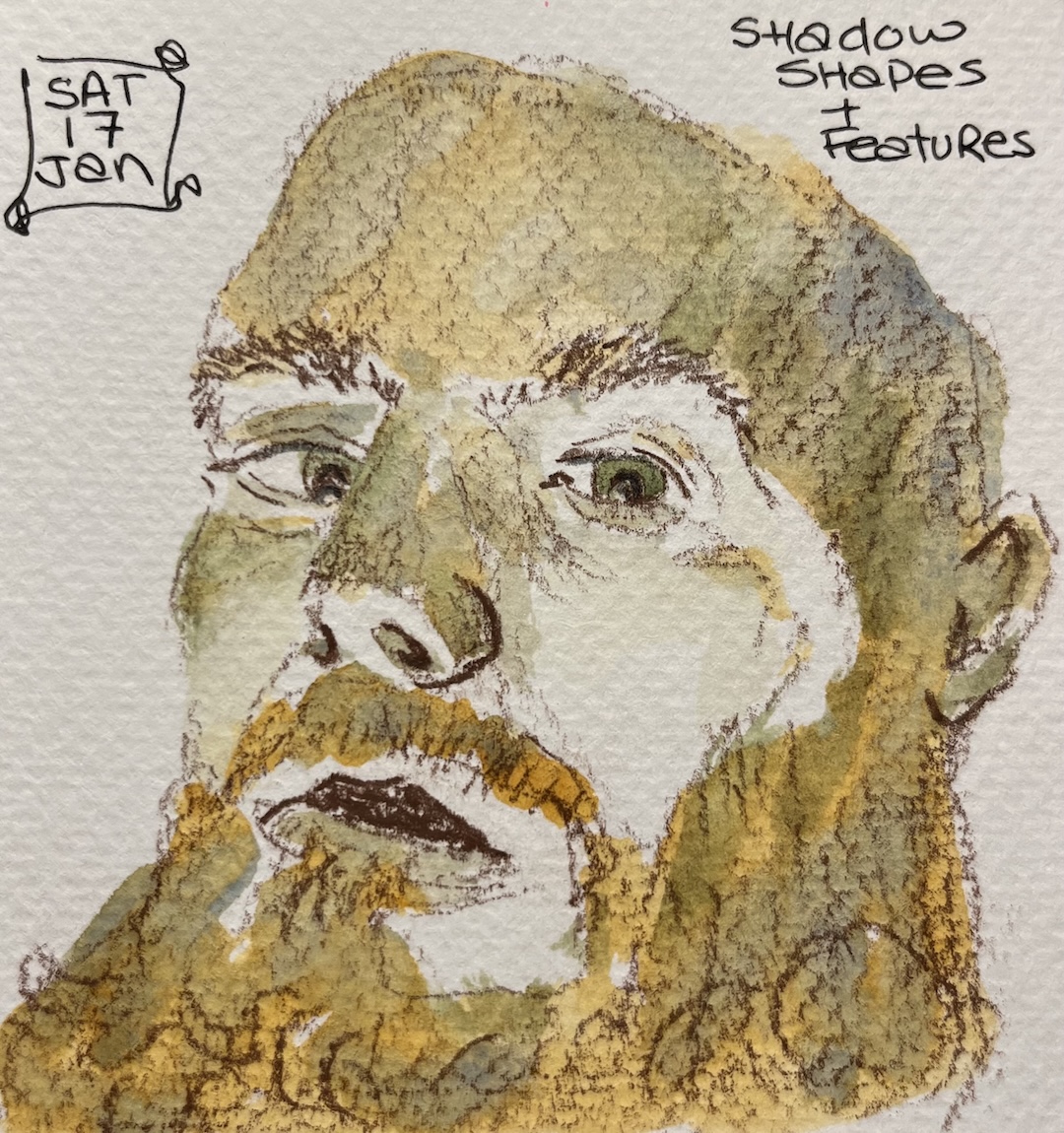
This two-stage approach was really effective for creating a complex looking portrait in two independent stages.
The final portrait illustrated the idea that you don’t have to draw everything that you see, you can just focus on what interests you. In my version I sketched in Olive Green Derwent Watercolour pencil, and then blended with some water.

In a nutshell, for sketching faces, here’s the key takeaways that resonated with me (although he did provide a lot more tips in the video):
- Figuring out how abstract shapes work together
- Refraining from drawing too many lines
- Be aware of evaluating angles and distances
- Focus on what catches your attention
- Identify what is going on got make the image interesting
- You don’t have to draw it all
If these approaches to sketching faces has piqued your interest, then I’d highly recommend watching this Tools and Tips to Help you Draw the Face video on YouTube.
YouTube Video: Tools and Tips to Help you Draw the Face
10 Minute YouTube Sketch with Dylan
I thought I was finished for the day, but then got sidetracked on today’s 10 Minute Portrait of Paul Rosolie. And because I’ve just been thinking in shadow shapes, I did three different shadow shape versions from the same source image.
- First I did a pure line drawing where I drew around the light and dark shadow shapes.
- Second I sketched in watercolour pencil, and where there were darker shadow shapes I added some water to blend the watercolour pencil together.
- Third I did a line drawing and then did single hatching for the lighter shadow shapes and cross hatching for the darker shadow shapes.

Line Drawing Shadow Shapes
I like the line drawing version the best. It’s basically doing a continuous line sketch, and I looked at the image and broke it into three different tonal values (white, mid-tone, dark tone) to simplify the portrait. Then drew lines around each of the tonal values I saw.
Marc Tarot Holmes was the inspiration around this style. I saw an interview of him a couple of weeks ago, and he said that when he’s out sketching people and he doesn’t have time to add tonal values, he’ll draw a tonal value shape (for example at the side of the nose), so that later if he shades or paints his people sketches, he can see where the shadow shapes are.


