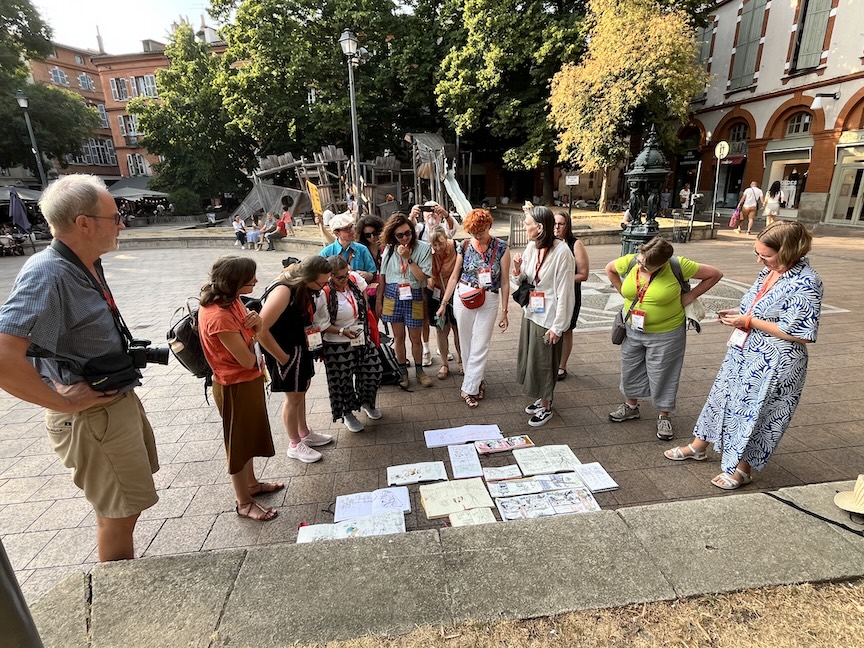
Workshop Session 3. Friday 17 July, 16:30 - 19:30 hrs
My Notes BEFORE I take this Workshop
This is the third workshop I’m attending on the afternoon of the third day of the Urban Sketcher’s Symposium in Toulouse. I chose it specifically because it centres around using reportage for telling everyday stories. I’m been intrigued by reportage recently, as a way to elevate my sketches from simple sketches of people to, sketches that tell a story. I’ve been using poetry to convey those stories and give context to the scenes I sketch, but wanted to know how to expand my knowledge of reportage and make it a key part of my sketching habit.
About the Workshop Instructor

Workshop Description

Supply List

Earlier in the day I’d attended the Rita Sabler lecture about reportage, and she uses it to document serious topics that require a lot of interviews and research to convey the serious story behind the scenes she sketches. I left that lecture feeling a bit deflated, because I don’t want to be a reporter who uses sketches to illustrate the story, I want to be an artist who wants to incorporate stories into her sketches. I left Rita’s lecture believing that reportage wasn’t really for me. I wasn’t looking forward to Versona’s workshop, and I’d totally got the wrong end of the stick about what reportage was, and how sketchers can incorporate it into their sketching practice. I wondered whether there was a reportage-light version, I could embrace instead, or whether I had to just carry on with my sketch+poetry approach, and stop calling it reportage.
My Notes AFTER I take this Workshop
As far as mind-blown with ideas and inspiration, this workshop delivered in spades. Veronica introduced us to her version of reportage, which was much closer to what I’d been imagining it as.
I suppose we shouldn’t really get limited by specifics and labels, but when you’re learning new skills it’s helpful to be able to put a name to the process you want to immerse yourself in. Reportage seems to be a multi-faceted beast with a variety of interpretations. But at the end of the day, Urban Sketching is all about telling stories, which is why it’s different from Plein Air sketching – which, although this is also done outside, it focuses on capturing light.
There are many different ways to tell those stories, and there’s no wrong or right way, it’s just your way. As long as you convey a story with your sketch, it’s an urban sketch. But is every urban sketch reportage? Where’s that line? I’ll let you know if I get clarity on this…..but for now, back to the workshop.
Capturing Vignettes
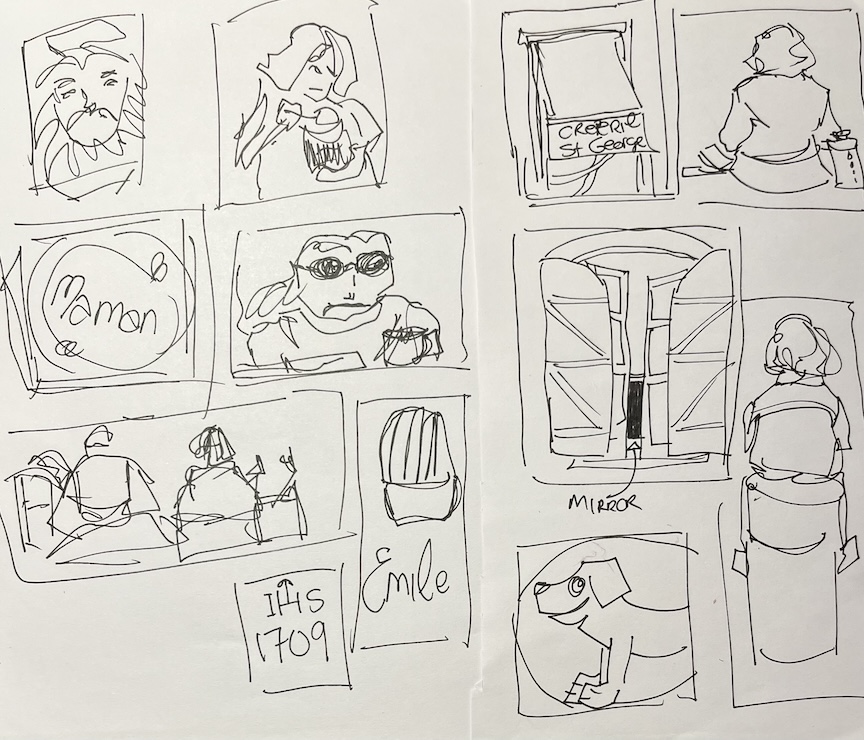
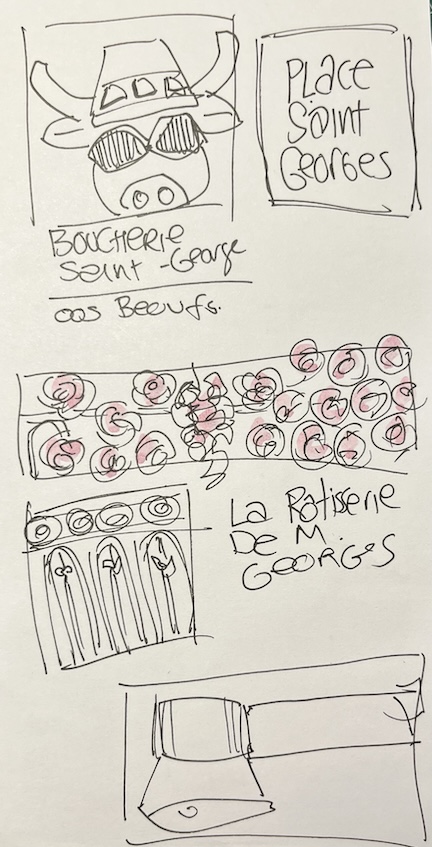
We started off by exploring the surrounding area of St. George’s Square, capturing little vignettes of small details that intrigued us. The intention wasn’t to try to create a story, but to start off by looking at what points of interest there were. My second sketch was of an old lady eating an ice cream, and that got me thinking about my Mum and England, and then I started to be attracted to elements that reminded me of home. But along the way I saw an open set of shutters in front of an open window, and a mirror on the wall in the room, and this was really intriguing to me.
Capturing Thumbnails
After we had our vignettes we used them to create a series of simple thumbnails to help to tell the story that was evolving in our minds. We had to approach it like we wanted to tell a story to somebody back home, but instead of conveying the story with words, we would use our sketches.
Similar to Dan Archer’s workshop, Veronica talked about thinking of scenes like a film director, and to envisage a wide shot, a mid-range shot, and a close up.
- For my big picture view (wide shot) I sketched the reflection of the bar opposite, in the mirror I’d seen on the wall of the building with open shutters and windows.
- For my medium shot I showed groups of people drinking wine and interacting at the bar that was reflected in the mirror.
- For my close up I sketched a person sitting along, with an empty glass, engrossed in her social media.

In the past I’ve just looked at a street scene that feels slightly inspiring to me, and started sketching it. If the scene or the person doesn’t inspire me, then I struggle to sketch it. But in this workshop it was all about spending more time getting to know the vicinity, and really taking notice of your surroundings to seeing what you really resonated with you, so that you could create a sketch you were really inspired by. This getting to know the area, was the same approach that Richard Briggs talked about in his workshop, and I can see how beneficial it is.
Reportage Sketch
For our final sketch we had about an hour to take the ideas we’d sketched out in our vignettes and thumbnails build them into a story. I basically took the big picture view, mid-range view, and close up I’d thumbnailed out, and combined them into a single sketch.
I think it was a bit out there – the top of my sketch was the open window on one side of the square capturing the reflection of the bar on the opposite side of the square. The canopy of the bar extended outside the window, and the rest of the sketch captures the scene at the bar (not a reflection of it), showing couples chatting with full glasses of wine, whereas the large single figure had an empty glass. The reflection of the bar windows in the mirror showed one bricked up window, and this was symbolic of the scene of the people shown below.
I have a tendency to create sketches where all the elements are in proportion with each other, but in my final reportage sketch, I made the solitary figure larger that the group of figures, as a way to give it more importance. This divergence in proportions is a really great tool for reinforcing the focal point in a sketch.
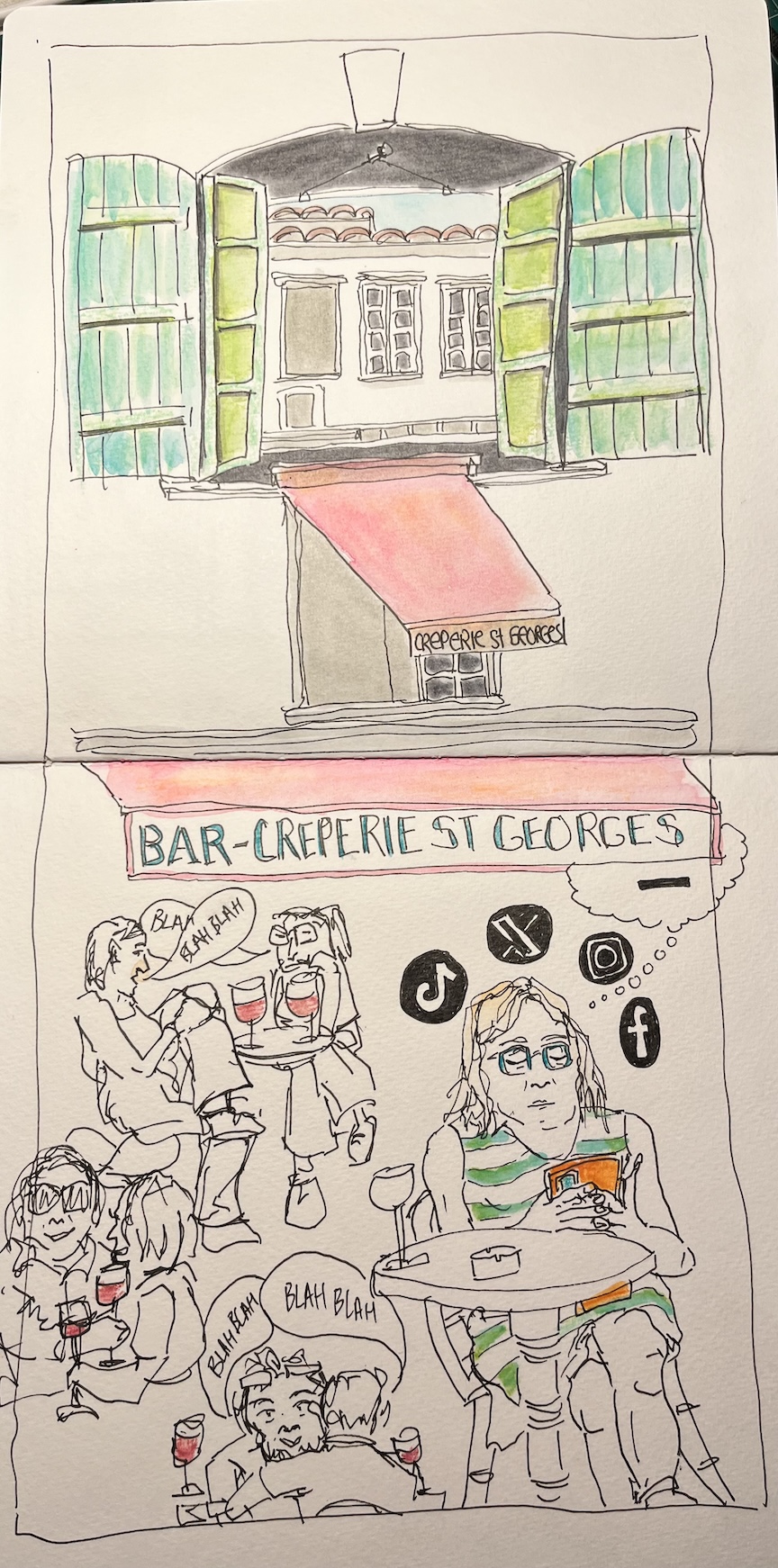
I think the sketch looked a bit confusing and had to be explained, because I wanted people to understand what I had sketched. Day’s later I realised that just because the artist has a story to tell, it’s ok if the viewer has a different interpretation of that story. The only important thing – in my opinion – is that the sketch tells a story, and the viewer is intrigued enough by your sketch to want to decipher it.
Veronica talked about creating reportage sketches that stop people in their tracks and compel them to study it and try to decipher the story it’s trying to tell. If you can do that with your art – then you’ve created a piece of reportage, that’s not just a pretty sketch.
My takeaways from this workshop was about looking at scenes like a film director and framing the scene as a big picture view, midrange view, or a close ups. This is related to the insights I’ve been learning while delving into Comic Strip Layouts. If you create comic strips using the same view point in every scene you sketch, then the comic strip will be boring. But I hadn’t thought about combining this same approach into a single urban sketches.
It seems related to looking at a sketch in terms of foreground, mid ground, and background. But I’m not clear about how these two ways of developing a sketch work together…I think that’s a topic for another blog post. Needless to say…I’m intrigued.
Throw Downs and Workshop Photos
After our sketching session we had a sketch throw down, and I also took some other photos.