

Loose Street Scene Sketches from Toulouse
Wonky Lines and Lost Lines
At the Urban Sketcher’s Symposium in Toulouse this year I started a severe fascination about drawing wonky lines, and I wondered why loose quick and wonky lines look so much better than a thoughtfully rendered slow straight line.
I sketched two detailed street scenes of Toulouse Building that both took me over an hour to complete. But my favourite sketch of Toulouse is a wonky blue door surrounded by a brick archway, sketched with continuous lines (bottom right).
And this got me thinking – why do I love my wonky lines so much?


I knew there had to be a scientific reason why I prefer the wonkiness – and because I’m always obsessed with “the why” – I headed straight down the rabbit hole of Gestalt Psychology to discover the why so that I could move onto the how. I need to intuitively strip down this concept to its bare bones to fully understand it, so that I can incorporate it into my urban sketching practice.
Gestalt Psychology
Turns out there’s some interesting research with neuro-scientific backing as to why loose and wonky lines win the game. Our brains aren’t passive cameras merely taking a copy of what we see, they’re actually complex predictive machines, and they go into overdrive when we look at a sketch made with wonky lines and make predictions to organise the sensory information it’s receiving.
This phenomenon is part of Gestalt psychology – which encapsulates the idea that “the whole is different from the sum of its parts”. Our brain looks at the wonkiness and predicts the best path through the sketch, and ignores the wonkiness and stray marks, and forms a whole image based on its predictions.
As I understand it, if you only draw one slowly rendered straight line – you’re leading your brain down a single path. There’s no room for error because there’s no ambiguity in the lines. But if you draw with wonky lines, you give your brain the freedom to jump into predictive mode and form the best version of the sketch that it can. This is what neuroscientists call predictive processing.
A single rigid lines forces your brain to be a critic about what’s wrong with your sketch (inner critic anyone?). Whereas a wonky line invites your brain to co-create the best version of the sketch.
Here’s the why behind the way your brain works and how we as urban sketchers can use it to our advantage.
The Gestalt Law of Closure
One of the sketching techniques I first encountered in Liz Steel’s Edges workshop, was about Lost Lines which is the concept of intentionally omitting a line and instead, leaving a gap where a boundary or edge should be. I’ve been critical of some of my most recent people sketches, because there’s not many lost lines. The lines look too solid and closed off, making the figures look static with not enough life or movement to them. If you close off all your lines, your sketches can end up looking like a colouring book sketch – too tidy, too complete, too flat.
When your eye encounters a broken line or incomplete boundary in your urban sketch, your brain automatically bridges the gaps. It’ll ignore the gaps and any stray marks, and goes into pattern completion mode, to predict a unified object. This is because our brains hate incomplete images, which triggers the Law of Closure, to use the surrounding information to mentally fill in the missing lines.
The Gestalt Law of Good Continuation
I’ve always wondered why I love my continuous line sketches so much. They always end up being a mass of wonky and restated lines, and they have such a vibrant and airy feel to them. Why, when there are 4 or 5 wonky lines on top of each other, does my brain not get confused? This is where the Law of Good Continuation comes into play. Our brains assume that all these overlapping lines intended to follow the same continuous path, and it averages all of the lines out to predict the best possible single line.
Urban Sketching Crossroads
I feel I’m at a cross-roads that could redefine my sketching style. Since getting back from the Symposium, I’ve been in a creative funk. I’d done a couple of sketches, but I’ve lost the passion for creating. My days usually centre around my creative exploits, but for the past week, I’ve been like a little dingy bobbing about in the water with no destination in mind. I’m hoping that now I have a grasp of the concepts behind wonky and lost lines, there will be land ahoy!
I’ve drawn my fair share of wonky lines in the past, but I need to more of them with more confidence, comforted by the knowledge that the wonkier the line, the more it’ll silence my inner critic and wake up my co-creator.
I sketched this little cafe sketch on the last day of the USk Symposium. I only had a biro on me, and I sketched with a mixture of loose lines and straighter lines. The objects ink this sketch I like the most are the tables and chairs. I used quick lines to capture the shapes, but not much detail. I did the same with the floral canopy above the shop.
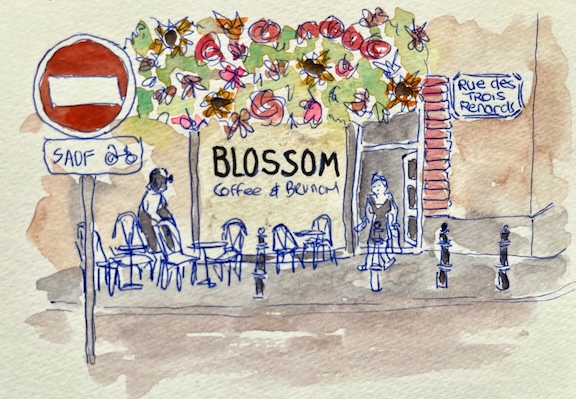
The bricks at the side of the door are too distracting, because I used solid lines to define all of the edges, and the contrast between the ink lines and watercolour are too dramatic and have created an unintended focal point. This area of the sketch would have worked better with Lost Lines, so I’m going to work on getting comfortable with my lines doing less work, and my watercolour shouldering more of the burden of defining edges.


